Palm 101

You’ve probably heard the horror stories about palm oil: orphaned orangutans, rainforest destruction, smoldering fires that pollute the air, displaced communities, and the exploitation of workers.

Thankfully, that’s not the whole story.

orangutans

As global demand for palm oil has surged over the past several decades—primarily in Indonesia and Malaysia, which now produce roughly 85% of the world’s supply—the industry has evolved in ways that too often prioritize profit over people and the planet. Enormous plantations, loss of biodiversity, and human rights violations have become unfortunate hallmarks of conventional palm oil production.

But there’s another, better story—one where palm oil is grown with integrity. A story in which farmers are empowered, communities thrive, animals are protected, and ecosystems flourish. Let’s begin there.

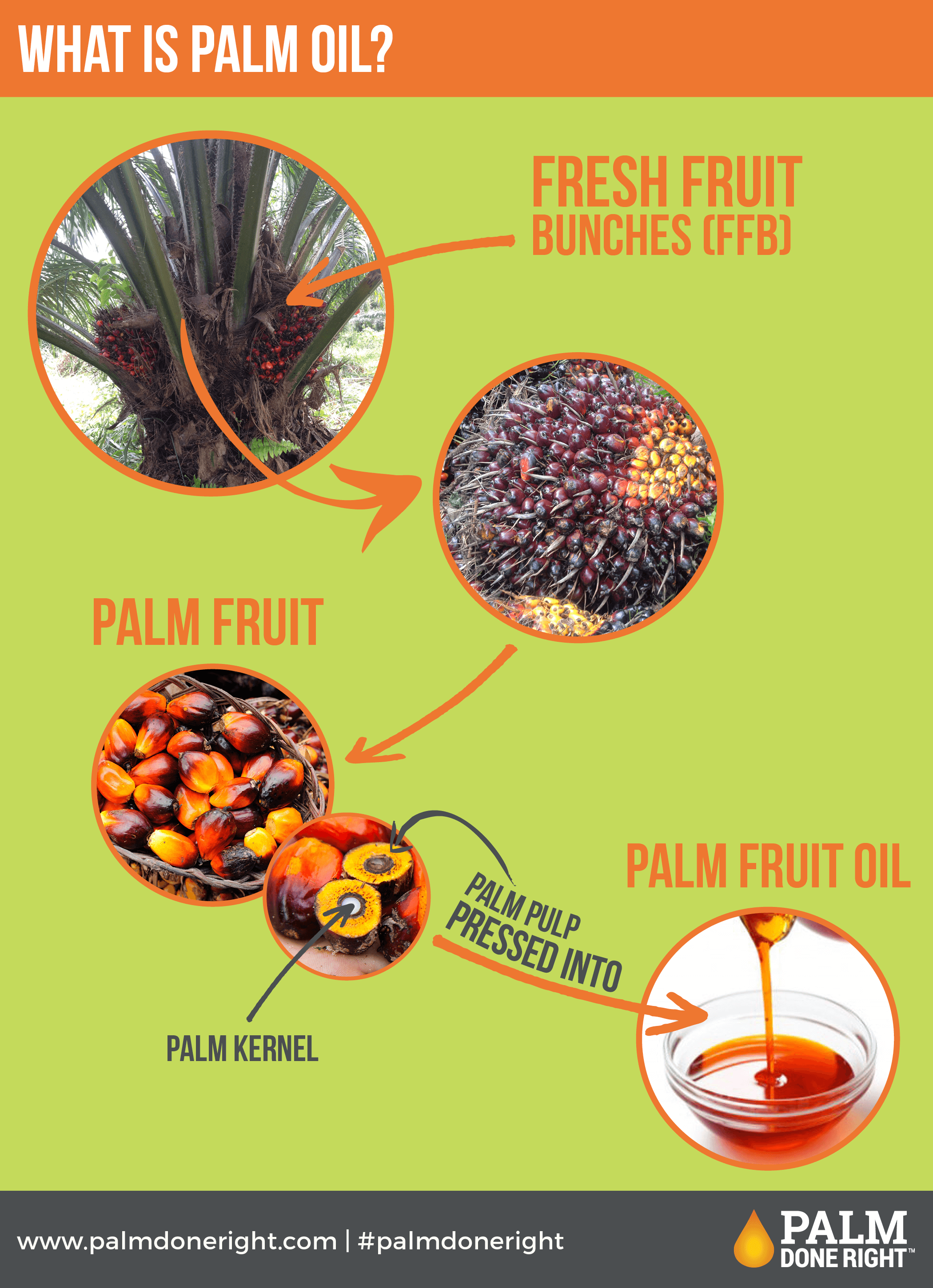
Palm oil is one of the most widely used vegetable oils in the world. It’s found in everything from food and household products to cosmetics and biofuels. Its popularity stems from its versatility, high yield, long shelf life, and low cost. In fact, it accounts for over 30% of global vegetable oil production.

However, the way most palm oil is produced has raised serious environmental and social concerns. Land clearing for plantations has led to deforestation and habitat destruction, threatening endangered species like orangutans and Sumatran tigers. Excessive use of pesticides and fertilizers has degraded soil and polluted water. In some regions, labor abuses—including unsafe working conditions and even child labor—have also been documented.

Yet not all palm oil is created equal. Efforts are growing to change how palm oil is produced and sourced—focusing on regenerative, ethical, and transparent practices. One such approach is Palm Done Right, which is founded on three core beliefs:

100% ORGANIC

Palm Done Right believes healthy, resilient ecosystems thrive through organic agriculture. That means absolutely no toxic or persistent pesticides, synthetic nitrogen fertilizers, antibiotics, synthetic hormones, genetic engineering, sewage sludge, or irradiation. Every product with the organic label guarantees full traceability—right back to the farm. Organic certification not only protects the soil, air, and water but also the health and well-being of farmers, workers, and surrounding communities.

DEFORESTATION-FREE

Palm Done Right farmers have maintained independent, third-party deforestation-free certification since 2014, with historical documentation extending back to 2005. Updated LUCA (Land Use Change Analysis) studies confirm every farm protects land integrity—ensuring each drop of palm oil supports conservation over conversion. To further this commitment, Palm Done Right uses STARLING satellite monitoring to track land use in real time, with full coverage expected across all farms by 2025.

FAIR

Ethical labor practices are non-negotiable. Palm Done Right works hand-in-hand with farmers to ensure everyone involved is treated with dignity and respect. That means seasonal and day laborers receive a living wage, and all plantations uphold strict human-rights standards—safe working conditions, access to healthcare and sanitation, adequate housing, and zero tolerance for child labor. All farmers have signed a binding code of conduct that puts these commitments into practice across 44 plantations.

These principles go beyond sustainability—they embody a holistic approach to palm-oil production that supports thriving communities and ecosystems.

When produced with care, palm oil can even offer potential health benefits. It’s a rich source of antioxidants like beta-carotene and tocotrienols—compounds linked to reduced inflammation, improved cholesterol levels, and lower risk of heart disease. Its balanced ratio of saturated and unsaturated fats makes it a valuable ingredient in cooking oils, baked goods, and more.

In personal care, palm oil’s moisturizing properties make it a popular choice in soaps, lotions, and shampoos.

And it’s not just functional—oil palms are the most efficient oil crop on the planet, yielding 5 to 10 times more oil per acre than soy, canola, or sunflower. When grown responsibly, palm oil has the potential to meet global demand with less land and lower overall impact.

Of course, the damage caused by conventional palm oil is undeniable. The destruction of native habitats, the release of carbon from peatlands, and the haze from burning practices have had devastating effects on biodiversity and communities alike.

But it doesn’t have to be this way.
Palm Done Right is not only possible—it already exists. And by supporting practices that are organic, deforestation-free, and fair, we can help shift an industry toward integrity, transparency, and long-term resilience.

Sustainable palm oil

Oil palms produce more oil per hectare than any other oil source on the planet.

How is Palm Done Right grown?

Palm Done Right Farmers grow oil palms according to organic practices, either by reconditioning degraded land—often from old growth forest that had been clear cut and converted into pasture or crop lands—or by transitioning existing, conventional palm farms to organic.

palm trees

Oil palm trees produce year round, with a life span of up to 40 years.

Oil palms are unique plants. They produce palm fruits for up to 40 years, which makes them less of a burden on the soil than annual crops that are replanted year after year, and they bear fruit year round, which means a steady source of income for small farmers. Palm Done Right farmers nurture the soil with organic methods like leguminous cover crops (which fix nitrogen in the soil naturally), mulching and application of compost, which also increases palm fruit yields.

How is Palm Done Right harvested?

Fresh fruit bunches ripen in 20 weeks, with the amount of oil from the yield increasing by 200 fold in the last week, meaning farmers need to monitor daily for ripe fruit. When the fruit is ripe, workers harvest by hand either by using a scythe fit on a long pole or by shimmying up the tree and using a machete to cut down the bunches.

palm plantation

Palm Done Right is harvested by hand using traditional methods.

Once the bunches are harvested, the farmers cart them to the mill (or the pick up point for the mill), often using donkeys, horses or oxen.

palm plantation

Palm Done Right favors animal transport where possible to cut down on fossil fuels.

How is Palm Done Right milled?

palm oil plantation

Fresh Fruit Bunches (FFBs) ready to be steamed.

  1. When the fresh fruit bunches reach the mill, they are transferred to a large container with pressurized steam which deactivates the enzyme that causes the oil to go rancid, and loosens the fruit from the bunch.
  2. Next, the bunches go into a large drum tumbler. The fruit falls through openings in the container, and the empty bunches are recycled as compost.
  3. The fruit then goes into a low-speed steam “digester” press that loosens the oil from the pulp, and then into a hydraulic press. At that point, the liquid is a mixture of oil, water, fiber and kernels.
  4. That mixture goes onto a vibrating screen to separate out the solids. Of the solids, kernels are gathered for a separate pressing, and the fiber is recycled as fuel for the steamers.
  5. The liquid goes to a clarifying tank that uses centrifugal force to separate water from oil.

One of the negative side effects of palm processing is that the wastewater from the purification step—because it’s highly concentrated organic matter—can contaminate water sources.

Part of Palm Done Right is making sure that doesn’t happen, by lining holding pools, or putting the wastewater through a “biodigester” that separates water—which is then safe to return to rivers or use as irrigation—and compostable organic matter.

aerated pools

Lined, aerated pools help turn wastewater into water suitable for irrigation or streams.

From there, the oil is transported to a refinery for further processing, depending on needs of the end product.

But Palm Done Right goes beyond just the production of palm oil. Palm Done Right is about nurturing the soil through organic practices, empowering farmers through education and cooperation, and nurturing communities through social programs and investment.

Frequently asked questions

What’s the difference between sustainable and unsustainable palm oil?

Unsustainable palm oil is linked to deforestationbiodiversity loss, and exploitation. Sustainable palm oil, like that from Palm Done Right, is organicdeforestation-freewildlife-friendly, and fair to workers and communities.

Is sustainable palm oil a viable alternative?

Absolutely. Palm oil is the most efficient vegetable oil crop, producing 5–10 times more oil per acre than alternatives. Done right, it meets demand while reducing pressure on forests.

Why is sustainable palm oil production important?

Conventional palm oil production has often resulted in deforestation, biodiversity loss, and labor exploitation. Sustainable palm oil, on the other hand, can support thriving ecosystems, fair labor practices, and community development. Palm Done Right shows that palm oil can be grown in harmony with people and the planet.

Where can I find Palm Done Right products?

Look for the Palm Done Right seal on product packaging in stores and online. Visit our website for a list of brand, retail, and business partners.

What makes Palm Done Right different?

We go beyond conventional standards. Palm Done Right is about real impact—from organic farming and zero deforestation to community empowerment and wildlife protection. We’re proof that palm oil can be a force for good.

Who is behind the Palm Done Right initiative?

Natural Habitats started Palm Done Right, an initiative supported by a collective of companies, organizations, and individuals committed to sustainable palm oil production. It is not affiliated with any single entity and we are not a certificate. Still, PDR aims to bring together stakeholders across the palm oil supply chain, including producers, processors, manufacturers, retailers, NGOs, RND and consumers.

How does Palm Done Right support farmers and communities?

We treat farmers as partners, not laborers. We pay fair wages, provide resources, and support community infrastructure like healthcare and education. Our goal is mutual respect and shared success.

Why You Should Get Involved
with Palm Done Right

Palm can be grown for good, bringing benefits to:

  • Our planet, due to palm oil’s land efficiency.
  • Local communities, due to the economic development oil palm production creates.
  • Our market, due to palm oil’s versatility and functionality as an ingredient, lifting product quality and performance.

Together, we can influence change for:

  • Manufacturers that are still using conflict palm oil for their products.
  • Retailers that are still listing products that contain conflict palm oil.
  • Brokers and distributors that are still supplying their customers with products that contain conflict palm oil.
  • Shoppers that have the power to vote with their dollar.

Get Involved


    Are you already using Palm Done Right Oil?


      NEXT